
Solar Power and Battery Storage Are Not Enough: Schneider Electric at SEE ENERGY 2026 Raises the Question of Intelligent Energy Management
How can a solar power plant, battery energy storage system and distribution grid be connected into a single, safe and economically efficient system? Schneider Electric, a global technology leader in the energy sector, will participate in SEE ENERGY 2026, taking place on 4–5 November in Novi Sad.
As part of the panel “CONTROL THE HYBRID POWER PLANT – SOLAR + BESS + GRID”, the company will contribute to the discussion on integrated energy resource management, technical grid requirements and new opportunities for industrial consumers.
Building a solar power plant for an industrial facility is no longer simply a matter of selecting photovoltaic panels, inverters and available roof or land area. With growing interest in battery energy storage, self-generation and active participation in the electricity market, industrial energy systems are becoming increasingly complex.
A factory that produces part of its own electricity, stores surplus energy and simultaneously draws electricity from the distribution grid must manage several interconnected processes.
When is it most economical to use self-generated electricity? When should the battery be charged, and when should stored energy be used? How can electricity export to the grid be limited, peak demand controlled and supply stability maintained when production demand changes suddenly?
The answers to these questions increasingly depend on digital technologies, automation and advanced energy management systems. This is precisely the area in which Schneider Electric develops solutions that connect electrical infrastructure, distributed energy resources, battery storage systems, monitoring and control systems, and software platforms for optimizing energy flows.
Schneider Electric: When Solar, BESS and the Grid Become One System
Schneider Electric is a global technology leader in the energy sector, with a portfolio that includes smart devices, automation, digital platforms, software-defined systems and technologies based on artificial intelligence.
The company operates in more than 100 countries, with approximately 160,000 employees and a network of around one million partners, providing solutions for industry, infrastructure, commercial buildings, data centres and power grids.
One of the key areas of its development is microgrids and the integrated management of distributed energy resources.
Through its EcoStruxure platform, Schneider Electric develops solutions for the design, monitoring, control and optimization of microgrids and distributed energy resources.
These solutions use advanced analytics, automation and predictive algorithms to optimize energy generation, storage and consumption, while coordinating different energy resources within a single system.
Combined with electrical equipment, protection devices and automation systems, these technologies make it possible for generation, consumption and energy storage to function not as separate elements, but as a coordinated and intelligently managed energy system.
For industrial users, this creates opportunities to use self-generated energy more efficiently, improve cost control and increase power supply reliability.
How Much Can Integrated Energy Management Affect System Economics?
In a study presented by Schneider Electric in August 2026, 65 microgrid application scenarios across 13 regions and five types of commercial buildings were analysed.
The study considered combinations of rooftop photovoltaic systems and stationary battery storage, supported by a controller optimized to reduce electricity costs.
The modelling results showed favourable economics for these systems in a significant number of analysed cases, with the best-performing scenarios forecasting a return on investment in less than ten years.
At the same time, the research emphasized that economic performance depends on local tariffs, consumption profiles, available solar resources and system design.
Another important effect was highlighted: a properly controlled combination of solar generation and battery storage can reduce peak electricity demand from the grid and contribute to more efficient use of existing distribution infrastructure.
For industry, the message is clear: the profitability of an energy project depends not only on the installed capacity of the solar power plant or the size of the battery, but also on how the entire system is managed.
DSO Requirements: Technical Integration Becomes a Key Part of the Investment
The development of hybrid energy systems in Serbia also raises questions about their connection to the distribution grid.
In September 2026, during the RES Serbia conference, energy sector representatives highlighted existing regulatory and technical constraints related to battery energy storage systems.
According to information presented at the time by representatives of Elektrodistribucija Srbije, the regulatory framework for stand-alone battery storage had not yet been fully developed, while most market interest was focused on combining solar power plants with batteries.
It was also emphasized that the procedure for adding a battery storage system depends on whether such a system was included in the original grid connection documentation.
These issues demonstrate the importance of considering the technical concept of an energy facility from the earliest stage of the investment process.
For hybrid systems, it is not enough simply to install appropriate generation and storage equipment.
A control system must also be designed to monitor and manage energy flows, comply with technical connection limits and respond to the requirements of the distribution system operator.
Power Plant Controllers (PPC), Energy Management Systems (EMS), SCADA systems, protection and metering equipment, as well as communication between individual plant components, all play an important role.
Their proper integration enables active and reactive power control, system monitoring, constraint management and coordinated operation of generation and storage assets.
The relationship between grid requirements and the capabilities of modern control technologies will therefore be one of the central topics of discussion at SEE ENERGY 2026.
From Reactive to Predictive Energy Management
Modern energy systems are increasingly moving from predefined operating rules toward predictive energy management.
A traditional approach may use a simple logic: the battery charges when there is excess solar generation and discharges during periods of higher demand.
In practice, however, industrial systems often require much more complex decisions.
Changes in production shifts, variable consumption, weather conditions, electricity market prices and grid connection constraints can significantly affect the optimal operating regime.
In its solutions, Schneider Electric develops an approach in which software uses consumption, generation and other relevant data to plan the operation of energy resources in advance.
This can allow the battery to be prepared for an expected peak load, enable self-generated solar electricity to be used at a more economically advantageous time, or reduce unnecessary electricity imports from the grid.
With the appropriate technical configuration and regulatory framework, advanced energy management systems can also contribute to greater flexibility for industrial consumers.
For factories considering investments in their own energy capacities, this means that technology decisions should be linked to an analysis of the consumption profile, business model and long-term energy objectives.
The Active Customer: A New Role for Industry in the Power System
Industrial companies have traditionally been viewed primarily as electricity consumers.
With the development of self-generation, battery storage and digital energy management systems, their role is changing.
An industrial facility can simultaneously act as a consumer, producer and owner of energy storage, while appropriate market and regulatory conditions may enable it to manage its relationship with the electricity system more actively.
This transformation creates opportunities for greater energy flexibility, but it also requires high-quality engineering, reliable automation and a clear understanding of market rules.
A particular challenge is aligning a company’s energy objectives with the requirements of its production process.
For industry, production continuity remains the priority.
Energy management systems must therefore enable energy optimization without compromising operational safety, power quality or reliability.
Schneider Electric sees the integration of electrification, automation and digitalization as a way for industrial facilities and energy infrastructure to operate as open, connected and intelligently managed systems.
SEE ENERGY 2026: How Do You Control a Hybrid Power Plant Under Real Operating Conditions?
These issues will be discussed at the international conference and energy technology exhibition SEE ENERGY 2026 – ENERGY FOR INDUSTRY, taking place on 4–5 November at Kulturna stanica Čeličana in Novi Sad’s District.
Schneider Electric will participate in the panel:
CONTROL THE HYBRID POWER PLANT – SOLAR + BESS + GRID
PV • BESS • PPC • Grid Integration • Optimal Sizing • Control • Safety
The discussion will focus on the practical challenges of integrating photovoltaic power plants, battery energy storage systems, control systems and the distribution grid.
Key questions of particular importance to investors, developers, EPC companies and industrial consumers will include:
-
How can a hybrid system be designed to meet both the user’s needs and the technical requirements of the grid?
-
What is the role of PPC, EMS and SCADA systems in managing solar generation and battery storage?
-
How should the optimal battery size be determined in relation to the solar power plant and the consumption profile?
-
How can energy flows at the grid connection point be controlled?
-
How can reliability, safety and coordinated operation of all plant components be ensured?
-
Which technical and regulatory barriers currently have the greatest impact on the development of hybrid projects in Serbia?
Schneider Electric’s participation in this discussion brings the perspective of a company developing technologies that integrate electrical infrastructure, automation and digital energy management systems.
Energy for Industry: From Individual Technologies to Integrated Solutions
The seventh edition of the SEE ENERGY conference, organized by the National Biomass Association SERBIO, brings together industrial companies, investors, developers, equipment manufacturers, engineering companies, system operators and financial institutions.
This year’s ENERGY FOR INDUSTRY focus raises the question of how industry can secure more affordable, reliable and cleaner energy in the coming years, supported by sustainable financing models.
The programme covers self-generation of electricity and heat, cogeneration, large heat pumps, waste heat utilization, waste-to-energy solutions, smart energy management, solar and battery systems, active customers and energy investment financing.
In addition to the conference programme, participants will have access to an exhibition of energy technologies and organized B2B meetings designed to connect industrial needs with concrete technological and investment solutions.
The future of industrial energy will not depend only on how much energy we can generate and store, but also on how intelligently we can manage it.
That is why the management of hybrid energy systems will be one of the key topics at SEE ENERGY 2026.
SEE ENERGY 2026 – ENERGY FOR INDUSTRY
4–5 November 2026
Kulturna stanica Čeličana, District, Novi Sad
International Conference | Energy Technology Exhibition | B2B Meetings
Information and registration: events-serbio.rs
SEE ENERGY 2026 at Čeličana: Energy Conference in Novi Sad
Where Novi Sad’s Industry Once Thrived, Its Energy Future Is Now Taking Shape
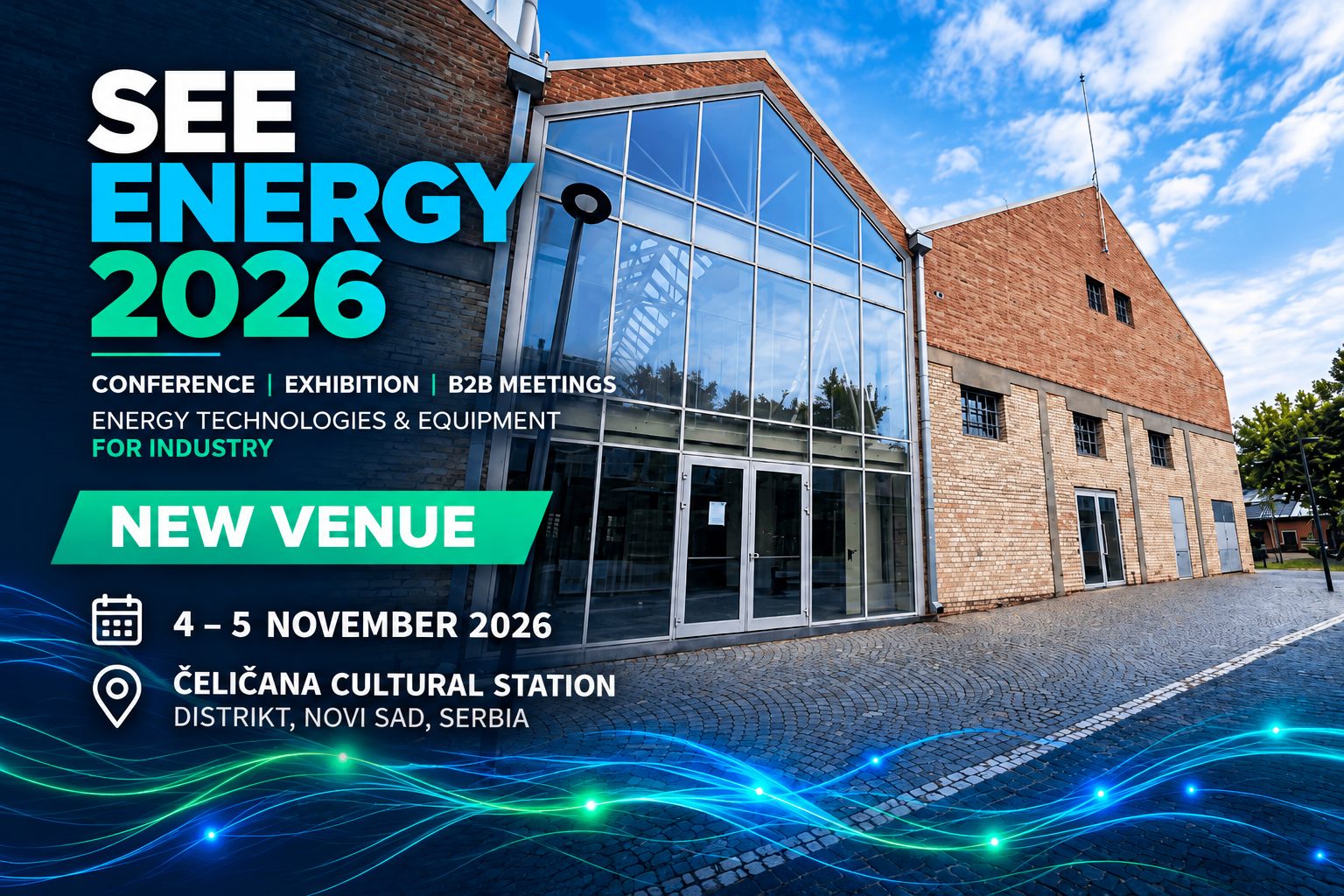
The international conference, energy technology exhibition and B2B meetings SEE ENERGY 2026 will take place on 4–5 November at the Čeličana Cultural Station, located in Novi Sad’s Distrikt.
The seventh edition of the international conference and exhibition SEE ENERGY 2026 – ENERGY FOR INDUSTRY, organised by the National Biomass Association SERBIO, will take place in a distinctive setting this year, providing a new backdrop for discussions on the energy future of industry.
The site of a former industrial complex in Veliki Liman, now part of Novi Sad’s Distrikt, will bring together representatives of industrial companies, energy and technology providers, investors and experts from Serbia and the wider region on 4–5 November.
The choice of Čeličana carries special symbolism: a location closely connected to the city’s industrial past will become a meeting place for discussions on the technologies, investments and energy solutions shaping the factories of tomorrow.
From Industrial Heritage to Modern Energy Technologies
Today’s Distrikt emerged from the transformation of a former industrial zone in Veliki Liman, one of Novi Sad’s important centres of economic development during the 20th century.
Former production facilities, workshops and industrial buildings are now being repurposed to accommodate cultural, creative and other contemporary activities. This unique environment adds a special dimension to this year’s SEE ENERGY event.
In the past, industrial companies invested in machinery, production lines and new manufacturing capacities. Today, they face an equally important investment challenge: how to secure a more reliable, cost-effective and sustainable energy supply, reduce production costs and remain competitive in the market.
SEE ENERGY 2026 connects these two eras of industrial development, placing practical technologies, investments and business models at the forefront of efforts to help industry address the energy challenges of the coming years.
What Can Visitors Expect to See and Learn?
Over two days, SEE ENERGY will bring together a professional conference, an exhibition of energy technologies and equipment, and targeted B2B business meetings.
The programme is primarily designed for medium-sized and large industrial companies, major energy consumers, energy utilities, investors, engineering and design companies, technology providers and financial institutions.
The conference will showcase solutions that enable industrial companies to generate, use, store and manage energy more efficiently, with a particular focus on technologies that can be implemented in existing production facilities.
Key topics of the expert panels will include:
-
Energy Inside the Factory: Gas engines and turbines, combined heat and power (CHP), industrial heat pumps and waste heat recovery.
-
Waste-to-Energy: Opportunities to convert industrial and other waste streams into useful energy, including waste-to-energy facilities.
-
Smart Energy Management: Digital systems, automation, monitoring and real-time energy consumption optimisation.
-
Solar Power Plants and Battery Energy Storage: Integrating renewable energy generation, battery storage and grid connections.
-
The Active Energy Consumer: How industrial companies can take a more active role in generating, consuming and managing their own energy.
-
Financing Energy Projects: How to turn a technological solution into a bankable investment attractive to financial institutions and investors.
The conference and exhibition programme of SEE ENERGY 2026 will bring together representatives of leading international and Serbian companies specialising in energy, industrial technologies and energy management.
Participants include Huawei Digital Power and SKE Engineering, the conference’s General Partners, as well as Sungrow, Schneider Electric, Siemens Energy, ABB, LG Electronics, INNIO Jenbacher, Wärtsilä, SK Solar, MT-KOMEX, Elixir Group, PowerGrid Engineering, Resalta, Wood Chips, and others.
The full conference programme is available here.
Through discussions with industry experts and company representatives, participants will gain insights into practical experience, advanced technological solutions and opportunities for their implementation in industrial production systems.
Energy Technology and Equipment Exhibition – Solutions Industry Can Put into Practice
Alongside the conference programme, visitors will have the opportunity to engage directly with international and Serbian companies developing, supplying and integrating advanced energy technologies.
The SEE ENERGY 2026 exhibition will feature solutions presented by Huawei Digital Power, SKE Engineering, Sungrow, Solar SK, Emerson and IvDam Process Control, covering solar energy, battery energy storage systems (BESS), power electronics, industrial automation and the integration of modern energy systems.
The exhibition will showcase technologies related to renewable energy, energy storage, control and automation, as well as other solutions designed for industrial energy systems.
The German-Serbian Chamber of Commerce (AHK Serbia) and the British-Serbian Chamber of Commerce (BSCC) will also have a presence in the exhibition area, further strengthening the event’s international business dimension and creating opportunities for direct business connections, knowledge exchange and new partnerships.
The exhibition aims to go beyond simply displaying equipment and technologies by directly connecting industrial energy users with manufacturers, suppliers and engineering companies.
Visitors will have the opportunity to discuss the specific needs of their production facilities, explore the practical application of new technologies and identify solutions to reduce energy costs and improve energy security.
B2B Meetings – From Technology Presentations to Real Projects
A key component of SEE ENERGY 2026 will be business meetings designed to connect industrial companies with technology providers, engineering partners, investors and financial institutions.
Through the B2B platform, participants will be able to present their needs, discuss planned investments and identify companies capable of contributing to the development and implementation of energy projects.
The programme will also highlight specific industrial challenges and projects seeking suitable technological, commercial or financial solutions.
Special emphasis will be placed on connecting companies with real energy needs and investment plans to partners capable of providing technology, engineering expertise, financing or project implementation.
In this way, SEE ENERGY goes beyond the traditional conference format, becoming a platform where expert discussions can develop into concrete business agreements and new investments.
“We Want Čeličana to Be a Place Where Projects Are Agreed Upon, Not Just Where the Future Is Discussed”
Jelena Bunčić, President of the National Biomass Association SERBIO, the organiser of SEE ENERGY, emphasises:
“The choice of Čeličana as the venue for this year’s SEE ENERGY has special significance for us. We wanted to connect a place that reflects Novi Sad’s strong industrial heritage with the technologies and investments shaping the future of industry today.
This part of the city was once a centre of industrial production and development. Today, we want it to become a meeting place for factories seeking energy solutions, companies developing new technologies, and partners capable of financing and implementing new projects.
Our goal is not simply to spend two days discussing the energy transition. We want industrial companies to leave Čeličana with valuable contacts, new ideas and investment opportunities that can help reduce their energy costs and strengthen their competitiveness.
This is where we see the most meaningful connection between the industrial past of this place and its future.”
Novi Sad as a Meeting Point for Industry, Technology and Investment
By hosting SEE ENERGY 2026 at the Čeličana Cultural Station, Novi Sad gains another opportunity to demonstrate its potential as a meeting point for industry, innovation and international business cooperation.
The conference connects industrial energy consumers with technology manufacturers, energy companies, experts, financial institutions and investors from Serbia and the wider region.
In a setting that reflects the city’s industrial development, discussions will focus on a new generation of energy systems – from more efficient use of heat and electricity to digital energy management, battery storage and investment financing.
Approximately 300 visitors per day are expected, including representatives of industrial companies, the energy sector, technology and engineering firms, investors and business decision-makers.
SEE ENERGY 2026 will therefore provide an opportunity to bring together industrial energy needs, advanced technologies and the capital required to turn new energy projects into reality – all in one place, in Novi Sad.
SEE ENERGY 2026 – ENERGY FOR INDUSTRY
4–5 November 2026 | Čeličana Cultural Station, Distrikt, Novi Sad, Serbia
International Conference | Energy Technology & Equipment Exhibition | B2B Meetings
More information and registration: www.events-serbio.rs
Batteries Are Changing the Game – Energy Storage as the New Currency of the Power System | SEE ENERGY 2025 Novi Sad
t
Batteries Are Changing the Game: How Energy Storage Becomes the New Currency of the Power System
For decades, the energy sector relied on a simple equation — produce, consume, balance. But with the rapid growth of renewable energy, those rules no longer apply.
The wind doesn’t always blow when we need it, the sun doesn’t shine at night, and demand never waits.
In this new reality, battery energy storage is becoming what oil once was — the new currency of energy stability.
Energy That Doesn’t Disappear — It Waits
Energy storage is where innovation, security, and economics converge.
Battery systems are no longer just a supporting technology; they are becoming the foundation of a new electricity market.
The ability to store excess energy and release it when it’s needed most introduces entirely new business models — peak shaving, load shifting, balancing services, and even real-time energy trading.
Europe has already entered a phase where batteries dictate grid stability and energy prices. Serbia, though still in its early stages, is catching up quickly — the first permits for standalone storage systems have been issued, and plans for over 200 MW of battery capacity are now part of the national energy strategy.
Between Innovation and Regulation
Serbia’s battery storage market currently stands between innovation and regulation.
On one hand, the industry shows strong interest: investors, renewable energy producers, and energy managers recognize the potential for flexibility and reliability.
On the other hand, the lack of a clear legal framework and defined market mechanisms for ancillary services and balancing responsibilities still slows down sector development.
Yet, as regional examples show, those who first establish functional models for energy storage will not only control their costs — they will control time, the most valuable resource of the modern energy world.
Industry Focus at SEE ENERGY 2025
These challenges and opportunities will take center stage at the panel discussion
“Battery Energy Storage – Industrial Applications and Return on Investment”,
held on October 29 as part of the SEE ENERGY 2025 – Connect & Supply conference in Novi Sad.
The panel will bring together experts and companies already implementing BESS (Battery Energy Storage Systems) — whether as standalone projects or integrated within hybrid renewable power plants.
Discussions will go beyond theory to explore real market conditions, technical challenges, regulatory barriers, and above all, economic reality — how much stability costs, and when battery investments truly pay off.
Technology and Experience in Practice
Among the panel participants, Gordan Vujičić, Director of Strategic Development at ENEL PS, will share insights from projects where advanced UPS, hybrid, and battery systems were implemented.
With over three decades of experience in critical infrastructure, data centers, healthcare, and industry, ENEL PS provides solutions where uninterrupted power supply means the difference between continuity and downtime.
Through partnerships with leading global technology providers, ENEL PS demonstrates that digitalization, monitoring, and energy storage are not an expense — they are tools for efficiency, resilience, and competitiveness.
The Future Belongs to the Flexible
As Serbia prepares for a new wave of renewable energy projects and the mandatory integration of storage capacities, one thing is clear: batteries are no longer optional — they are essential.
In a system where both energy and time can be stored, those who can manage flexibility will become the new market leaders.
On October 29 in Novi Sad, this discussion will go beyond technology — it will be a conversation about the future of energy, an industry learning to plan in hours instead of years, and a new economy where stored energy is worth more than wasted energy.
SEE ENERGY 2025 – Connect & Supply
October 28–29, 2025 | Master Center, Novi Sad
www.events-serbio.rs




Latest news
- Solar Power and Battery Storage Are Not Enough: Schneider Electric at SEE ENERGY 2026 Raises the Question of Intelligent Energy Management
- From Waste to Energy: Elixir Group Presents the Eco Energy Waste-to-Energy Plant in Prahovo at SEE ENERGY 2026
- H-Bridges at SEE ENERGY 2026: Young Engineers Showcase Energy Innovations
- One Million Tonnes of Waste Converted into Energy in Vinča
- Sungrow at SEE ENERGY 2026: How Battery Storage and Solar Energy Are Transforming the Future of Industry
- LG Electronics at SEE ENERGY 2026: Can Waste Heat Become a New Energy Source for Cities?
- SEE ENERGY 2026 at Čeličana: Energy Conference in Novi Sad
- INNIO Jenbacher at SEE ENERGY 2026: Energy for Industry
- H2 Conference 2026: Green Hydrogen as a Roadmap for Energy Transition
- Innovative Biomass Heating Solutions for a Sustainable Energy Future - HARGASSNER Serbia
Contact
National Biomass Association SERBIO
Vladike Ćirića 2, 21 000, Novi Sad, Serbia
Phone: +381 62 179 0383
e-mail: This email address is being protected from spambots. You need JavaScript enabled to view it.

BioRES Project - Sustainable Regional Supply Chains for Woody Bioenergy has received funding from the European Union's Horizon 2020 research innovation programmer under grand agreement No 645994
The establishment of the National Biomass Association SERBIO was supported by:
